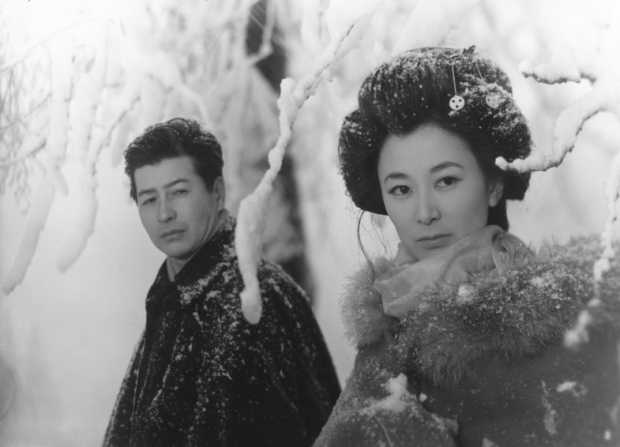
Snow Country (1957): A Exploration of Love and Isolation

kickstand-project.org – “Snow Country” (雪国, Yukiguni) is a 1957 Japanese drama film directed by Shirō Toyoda, which beautifully adapts the poignant novel by Yasunari Kawabata. The film is a compelling portrayal of the complex emotional landscapes of its characters, set against the serene and isolating backdrop of Japan’s snow-draped regions. It was featured at the 1958 Cannes Film Festival, marking its significance in the international cinematic landscape.

Plot Overview

The film tells the story of Shimamura, a wealthy dilettante from Tokyo, who travels to a remote hot spring town in the winter. Here, he rekindles an affair with Komako, a local geisha, with whom he shares a complicated and doomed romance. The narrative unfolds amidst the stark and captivating beauty of the snow country, where the harsh climate mirrors the emotional distance between the characters.

Themes and Cinematic Style

“Snow Country” elegantly captures themes of unfulfilled desire and the transient nature of beauty and love. The film employs a minimalist style, much like Kawabata’s literary technique, focusing on subtle emotional expressions and the evocative use of silence. The cinematography plays a crucial role, with the snowy landscapes serving as a metaphor for the isolation and inner turmoil of the characters.

Reception and Legacy

Upon its release, “Snow Country” was praised for its faithful adaptation of Kawabata’s novel and its artistic direction. The film is often lauded for its visual poetry and the delicate handling of its source material’s themes. Its entry into the Cannes Film Festival helped to cement its status as a classic in Japanese cinema, showcasing the depth and complexity of Japanese storytelling to a global audience.

Conclusion

“Snow Country” remains a significant work in the canon of Japanese film, offering a haunting exploration of love and loneliness. Shirō Toyoda’s adaptation not only honors Yasunari Kawabata’s literary masterpiece but also elevates it through the visual medium, creating a timeless narrative that continues to resonate with audiences today.

From Isolation to Integration: Albania’s Transformation

kickstand-project.org – Albania, a small country nestled on the Balkan Peninsula, has undergone a remarkable transformation over the past few decades. Once isolated from the rest of the world, it has embarked on a journey towards integration with the global community. This transformation is not just political and economic but also social and cultural, reflecting the country’s determination to leave its past behind and embrace a future of cooperation and partnership.

The Isolation Years

During the communist regime, which lasted from the end of World War II until 1991, Albania was one of the most isolated countries in the world. The government, led by Enver Hoxha, pursued a policy of self-reliance and autarky, severing ties with the Soviet Union and China, its former allies. The country was surrounded by a wall of silence, with strict controls on travel, information, and trade. The regime’s paranoia led to the construction of hundreds of thousands of concrete bunkers, symbols of Albania’s isolation and fear of invasion.

The Path to Democracy

The fall of the Berlin Wall in 1989 and the subsequent collapse of communism in Eastern Europe inspired Albanians to demand change. In 1991, following widespread protests and a brief period of violence, the first multi-party elections were held, marking the end of the communist dictatorship. The transition to democracy was not smooth; it was accompanied by economic hardship, political instability, and social unrest. However, it laid the foundation for Albania’s integration into the international community.

Economic Reforms and Growth

One of the key aspects of Albania’s transformation has been the implementation of economic reforms aimed at liberalizing the economy and attracting foreign investment. The country has moved from a centrally planned economy to a market-based one, privatizing state-owned enterprises and opening up to international trade. These reforms have led to significant economic growth, although challenges such as corruption and a large informal economy remain.

Integration into Europe

Albania’s strategic goal has been integration into the European Union (EU). This process began in 2009 when Albania joined NATO, a significant step towards its alignment with Western institutions. In 2014, the country was granted EU candidate status, and since then, it has been working on fulfilling the criteria for membership, including judicial reform, the fight against corruption, and the protection of minorities.

Cultural and Social Changes

The transformation of Albania is also evident in the cultural and social sphere. The opening up of the country has led to an exchange of ideas, an increase in cultural production, and a more vibrant civil society. Young Albanians, in particular, are embracing new opportunities for education, employment, and travel, contributing to a more open and dynamic society.

Challenges Ahead

Despite the progress made, Albania faces several challenges on its path to full integration. Economic development is hampered by a lack of infrastructure, a weak judicial system, and high levels of corruption. There is also the challenge of managing migration, both of Albanians seeking better opportunities abroad and of refugees passing through the country.

Conclusion

Albania’s transformation from isolation to integration is a testament to the resilience and determination of its people. While the journey has not been easy, the country has made significant strides towards becoming a stable, democratic, and prosperous member of the European family. As Albania continues to navigate the complexities of integration, it remains committed to the values of freedom, democracy, and human rights that have guided its transformation.